Artificial grass around a pool - resistance to chlorine, water and intense sunlight
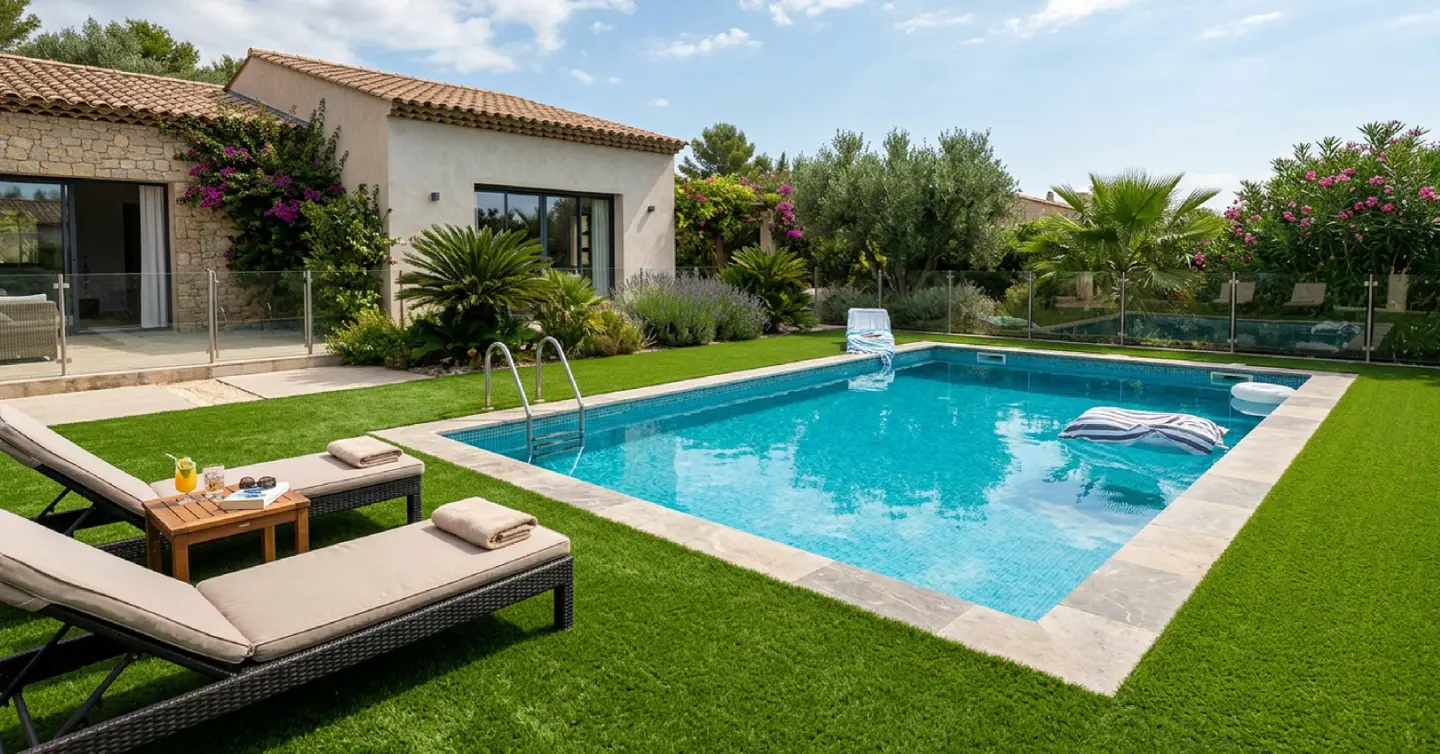
Why Is Natural Grass Around a Pool a Bad Idea?
Before we move on to artificial grass, it is worth understanding why natural grass around a pool performs so poorly. Chlorinated water splashed by swimmers damages the natural turf wherever it comes into regular contact. Wet feet and the constant movement from pool to lawn wear the grass down in a short time. Fertilised and carefully maintained natural grass around a pool means a costly and labour-intensive battle against inevitable deterioration.
An additional problem is the dirt that natural grass carries into the pool. Clippings, soil, insects and other organic contaminants that swimmers bring in on bare feet from the lawn are a problem for the filtration system and water hygiene. Synthetic turf around the pool eliminates this issue entirely - a clean, synthetic surface introduces no organic contaminants into the water.
Artificial Grass Resistance to Chlorine and Pool Chemicals
Chlorine used to disinfect pool water is a powerful oxidising agent that attacks many materials at high concentrations. How does synthetic turf respond to it?
The polyethylene and polypropylene fibres from which landscape artificial grass is made are chemically resistant to chlorine at the concentrations used in domestic pools - typically 1-3 mg/l. This is considerably lower than the concentrations found in commercial pools, where synthetic turf is the standard surface solution.
The latex or polyurethane backing is also resistant to typical pool chemicals. However, when choosing artificial grass for pool applications it is worth selecting products whose manufacturer explicitly declares resistance to chlorine and pool maintenance products - and supports that claim with technical documentation.
Algaecides, pH correctors and the periodic chlorine shock treatment are substances at higher concentrations that can, with prolonged contact, affect certain elements of the backing. Correct drainage that prevents pool water from collecting under the turf is the key protection against prolonged chemical contact with the backing.
UV Resistance - the Critical Parameter Around a Pool
The area around a pool is typically a space in full sunlight - deliberately designed that way so that the water and the swimmers benefit from as much sun as possible. This means artificial grass around a pool is exposed to several thousand hours of intense UV radiation every year.
UV radiation is the primary cause of degradation in plastics - it causes colour fading, fibre brittleness and loss of elasticity. Landscape artificial grass without adequate UV stabilisation can lose its colour and mechanical properties after just a few seasons of intense sunlight exposure.
When choosing synthetic turf for a pool always check the UV resistance certificate. The ISO 105-B02 standard defines the UV resistance class on a grey scale from 1 to 8. For intensely sun-exposed applications such as pool surroundings, the minimum required class is 6-7. Class 8 is the highest standard - the product retains its colour and properties for at least 10-12 years of intensive exposure.
Anti-Slip Safety - the Priority Around a Pool
A wet surface around a pool is the most common setting for accidents - slips and falls are the typical injuries in a pool zone. Every surface used around a pool must provide adequate grip on a wet substrate.
Artificial grass around a pool, unlike ceramic tiles or smooth stone surfaces, has a naturally rough fibre structure that provides grip even when wet. Bare feet coming out of the water find far better traction on artificial turf than on slippery tiles.
When purchasing artificial grass for a pool zone, check the anti-slip test results on a wet surface - the manufacturer should state the coefficient of friction for both dry and wet conditions.
Pool Drainage - Special Requirements
The area around a pool is a space where there is an exceptionally large amount of water - water carried out by swimmers, splashed during jumps and from an outdoor shower. The drainage system of artificial grass around a pool must cope with very large quantities of water without forming puddles.
A minimum drainage rate of 20-25 l/m²/h is the requirement for grass around a pool - you cannot choose the cheapest product with minimal drainage here. The subfloor beneath the turf must be equally permeable - a layer of gravel or quartz sand of the appropriate grade, with the right gradient towards the drainage outlets.
The edges of the turf at the pool surround must be tightly executed - water must not be able to get under the turf through gaps at the pool edge. Sealing with adhesive for synthetic surfaces or a specialist edge strip at the pool surround is standard practice.
Maintaining Artificial Grass Around a Pool
Maintaining artificial grass around a pool is straightforward but requires regularity. Daily or regular rinsing of the surface with water removes chlorine, chemicals and fine contaminants that could damage the material over time. Brushing every few weeks keeps the fibres in an upright position and unblocks the drainage.
If a chlorine shock treatment is being used - a single heavy chlorination of the pool - it is worth wetting the surrounding turf with water beforehand to reduce the contact of concentrated chlorine with the fibres.
Summary
Artificial grass around a pool is a solution that combines aesthetics with functionality and safety. Resistant to chlorine and pool chemicals, quick-drying, non-slip on wet surfaces and attractive throughout the season - it is a surface made for the pool environment. The key is choosing a product with a certified UV resistance of at least class 6 and a drainage rate above 20 l/m²/h.
You might also like

Why artificial grass is the best choice for your garden, balcony, or terrace
Artificial grass is a modern and convenient solution that works perfectly in the garden, on the balcony, and on the terrace. Thanks to its durability and minimal maintenance requirements, it is a practical alternative to natural grass, providing an aesthetic appearance all year round. Artificial grass in rolls allows you to quickly create a green space that is functional, comfortable, and easy to maintain.

3 proste kroki, które pozwolą Ci utrzymać piękny wygląd sztucznej trawy
Artificial grass is a convenient and aesthetic solution that, with proper care, maintains its beautiful appearance for years. Regular cleaning, brushing, and checking the base are enough to keep artificial grass surfaces looking like new. Thanks to this, artificial grass in rolls is a practical alternative to natural grass, which requires much more maintenance.

Artificial Grass for Pets – A Safe and Easy-to-Maintain Solution for Your Garden
Artificial grass is a convenient and pet-friendly solution for gardens and outdoor spaces. It is soft, durable, and safe for dogs and cats, while also being extremely easy to keep clean. The surface can simply be rinsed with water or washed with water and a small amount of regular dish soap, which is completely safe for pets and the environment. This makes it easy to maintain a clean, mud-free garden all year round.