Vibration Isolating Mats
Vibration and noise reduction in railway tracks
Vibration isolating under-track mats designed for use in railway tracks (railway, tram and metro). They reduce dynamic impacts from rail vehicle traffic on the surroundings of their routes, damping vibrations and secondary noise emitted by vibration-excited elements of building structures and engineering objects.
Product documents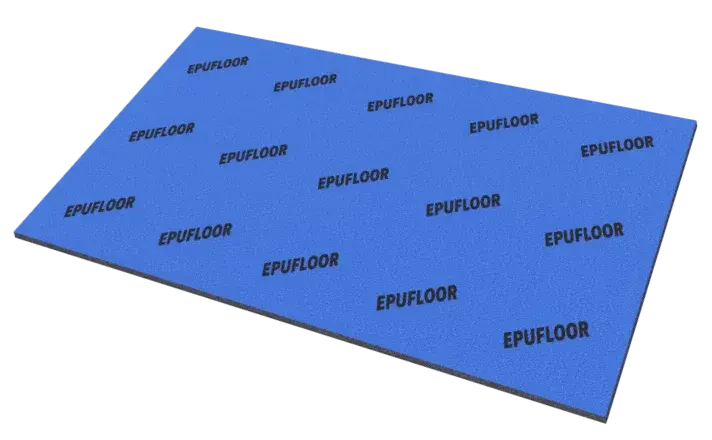
Types of Vibration Isolating Mats
Under-ballast mats
For ballasted track, effective on rigid substrates
Under-slab mats
For ballastless constructions, under concrete slabs
PUR Composite
Made of recycled polyurethane, effective vibration reduction
More information
Vibration isolating under-track mats are designed for use in railway tracks (railway, tram and metro) to reduce dynamic impacts from rail vehicle traffic on the surrounding areas. The reduction includes damping of vibrations (material vibrations) and noise – primarily so-called secondary noise emitted by structural elements of buildings excited during vehicle passage.
Under-ballast mats (also called sub-ballast mats) – often referred to by English abbreviations UBM and/or SBM (Under Ballast Mats or Sub Ballast Mats) are designed for ballasted track construction to be laid on the substrate under the ballast layer. Under-ballast mats are particularly effective on rigid substrates such as concrete tunnel invert, concrete or steel ballast trough on bridge structures. Additionally, UBM/SBM mats, by increasing the contact surface area at the subgrade-ballast interface, reduce stresses in the subgrade and ballast, slowing down the rate of ballast grain crushing.
Under-slab mats – often referred to by English abbreviations USM and/or STM and/or MSS (Under Slab Mats, Slab Track Mats and Mass Spring System) are designed for ballastless track constructions. They are installed under concrete base slabs, prefabricated track slabs, or longitudinal foundation beams under track framework. USM/STM/MSS mats are typically used to limit the impact of the track on the surroundings by reducing vibrations generated during the passage of rail vehicles, and consequently, reducing the secondary noise emitted by excited structural elements of buildings located along the railway line.
SBR (Styrene-Butadiene Rubber) elastomer is a synthetic rubber with excellent damping properties. It is characterized by high abrasion resistance, elasticity over a wide temperature range and long service life.
Primary polyurethane (PU) is a synthetic material with exceptional elastic properties. Manufactured from primary raw materials, it offers the highest quality and parameter repeatability.
PUR composite is a product of secondary reuse of synthetic polyurethane foam. Thanks to the possibility of blending with different types of primary material, using various bonding processes, and utilizing different degrees of feedstock fragmentation, a product with a wide range of vibration damping effectiveness can be obtained.
Looking for the optimal solution?
Our experts will help you choose the right system.
Contact us – we will advise, conduct effectiveness analysis and propose an ideal solution for your investment.
Contact us